DBT Worksheets: Free Printable DBT Skills PDFs – Dialectical Behavior Therapy (DBT) worksheets are practical, evidence-based tools designed to help you develop skills for managing intense emotions, tolerating distress, improving relationships, and practicing mindfulness. Originally developed for borderline personality disorder (BPD), DBT and its worksheets now support people dealing with emotion dysregulation, self-harm, substance use challenges, PTSD, anxiety, depression, and more.
If you’re in the United States looking for actionable ways to build emotional resilience, these printable worksheets offer structured exercises you can use between therapy sessions or as part of self-guided skill practice (with professional guidance recommended for best results).
What Is DBT and Why Do Worksheets Matter?
DBT is a structured form of cognitive-behavioral therapy developed in the late 1980s and 1990s by psychologist Dr. Marsha M. Linehan at the University of Washington. It combines acceptance strategies with change-oriented skills, creating a “dialectic” that validates your current experiences while teaching practical tools for a better life.
Comprehensive DBT typically includes:
- Individual therapy
- Group skills training
- Phone coaching
- Therapist consultation teams
DBT worksheets (also called handouts or practice sheets) turn abstract skills into concrete, repeatable exercises. They help you track progress, practice between sessions, and apply concepts like “Wise Mind” or “Radical Acceptance” in real-life situations. Research, including studies highlighted by the National Institute of Mental Health (NIMH), shows DBT improves emotion regulation and can reduce suicide risk and self-harm behaviors, particularly in youth and those with intense emotional experiences.
Recent reviews and meta-analyses continue to support DBT’s effectiveness for BPD, self-injurious behaviors, and related conditions, with adaptations showing promise for PTSD and other challenges.
The Four Core Modules of DBT Skills
DBT organizes skills into four main modules. Worksheets target specific skills within each:
- Mindfulness — Observe, describe, and participate in the present moment without judgment. Includes “What” skills (observe, describe, participate) and “How” skills (nonjudgmental, one-mindful, effective).
Example worksheets: Wise Mind practice, What Skills tracking, How Skills checklists. - Distress Tolerance — Survive crises without making the situation worse. Key skills include TIPP (Temperature, Intense exercise, Paced breathing, Progressive relaxation), STOP, IMPROVE, Self-Soothe, and Radical Acceptance.
Example worksheets: Urge Surfing, Crisis Survival Skills, Half-Smiling & Willing Hands, Turning the Mind. - Emotion Regulation — Understand, label, and change emotions when desired. Includes PLEASE skills (treat PhysicaL illness, balanced Eating, Avoid mood-altering drugs, balanced Sleep, get Exercise), Opposite Action, and Check the Facts.
Example worksheets: PLEASE Skill application, Emotion Regulation tracking, Opposite Action planning. - Interpersonal Effectiveness — Ask for what you want, say no effectively, and maintain self-respect and relationships. Core skill: DEAR MAN (Describe, Express, Assert, Reinforce, Mindful, Appear confident, Negotiate).
Example worksheets: DEAR MAN communication scripts, GIVE (Gentle, Interested, Validate, Easy manner), FAST (Fair, no Apologies, Stick to values, Truthful).
Some programs, especially for adolescents (DBT-A), add “Walking the Middle Path” skills for balancing acceptance and change with family or caregivers.
DBT Worksheets: Free Printable DBT Skills PDFs
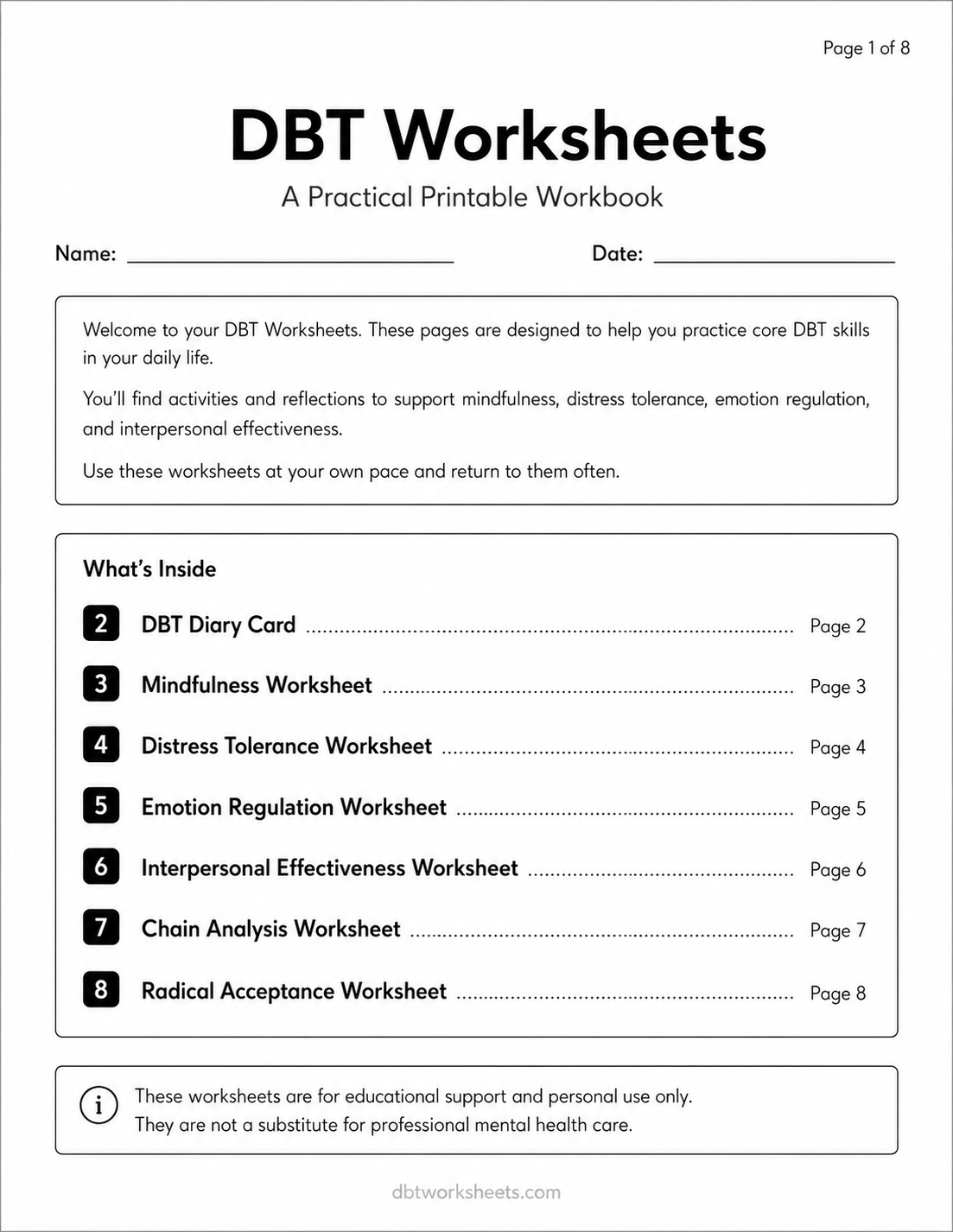
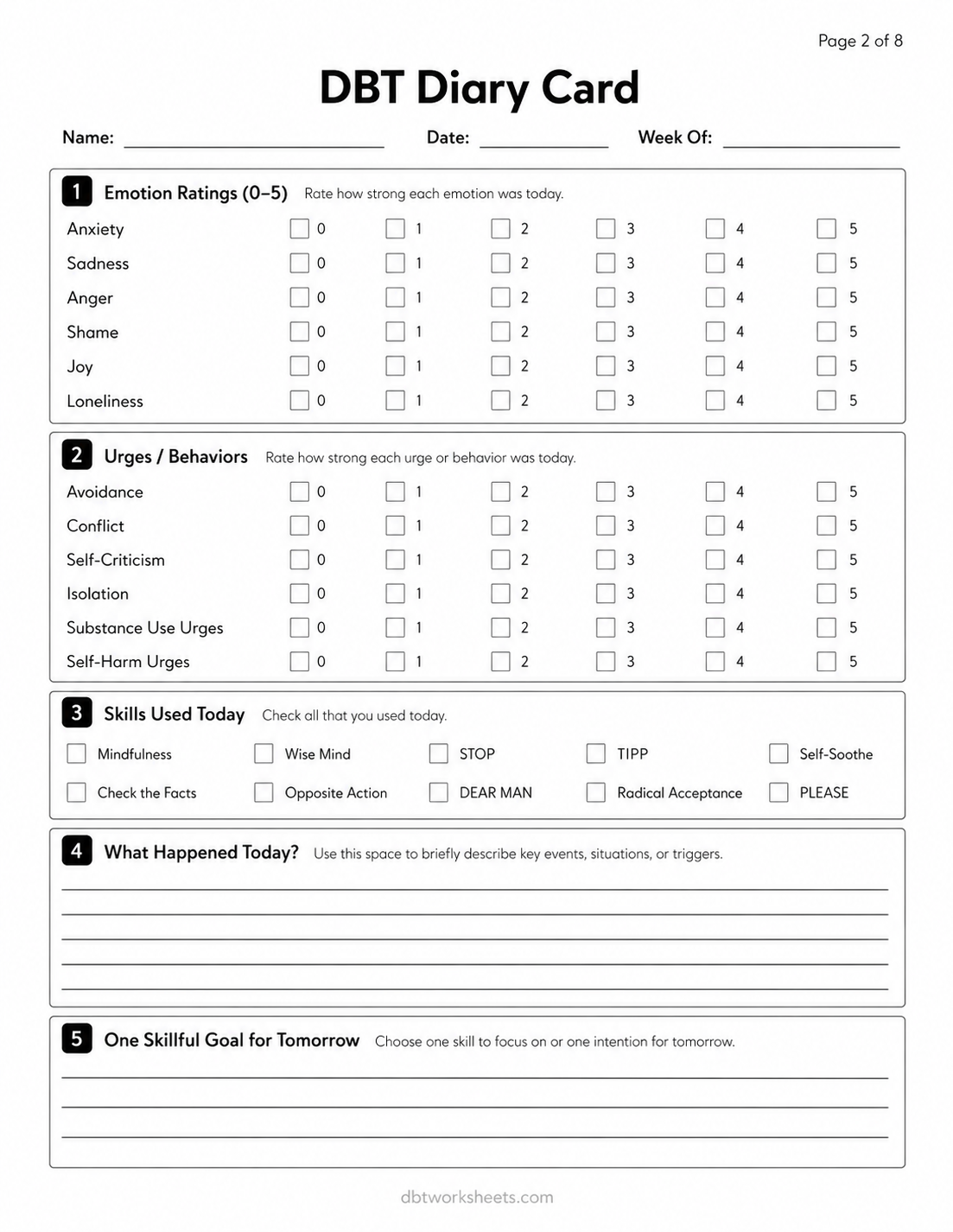
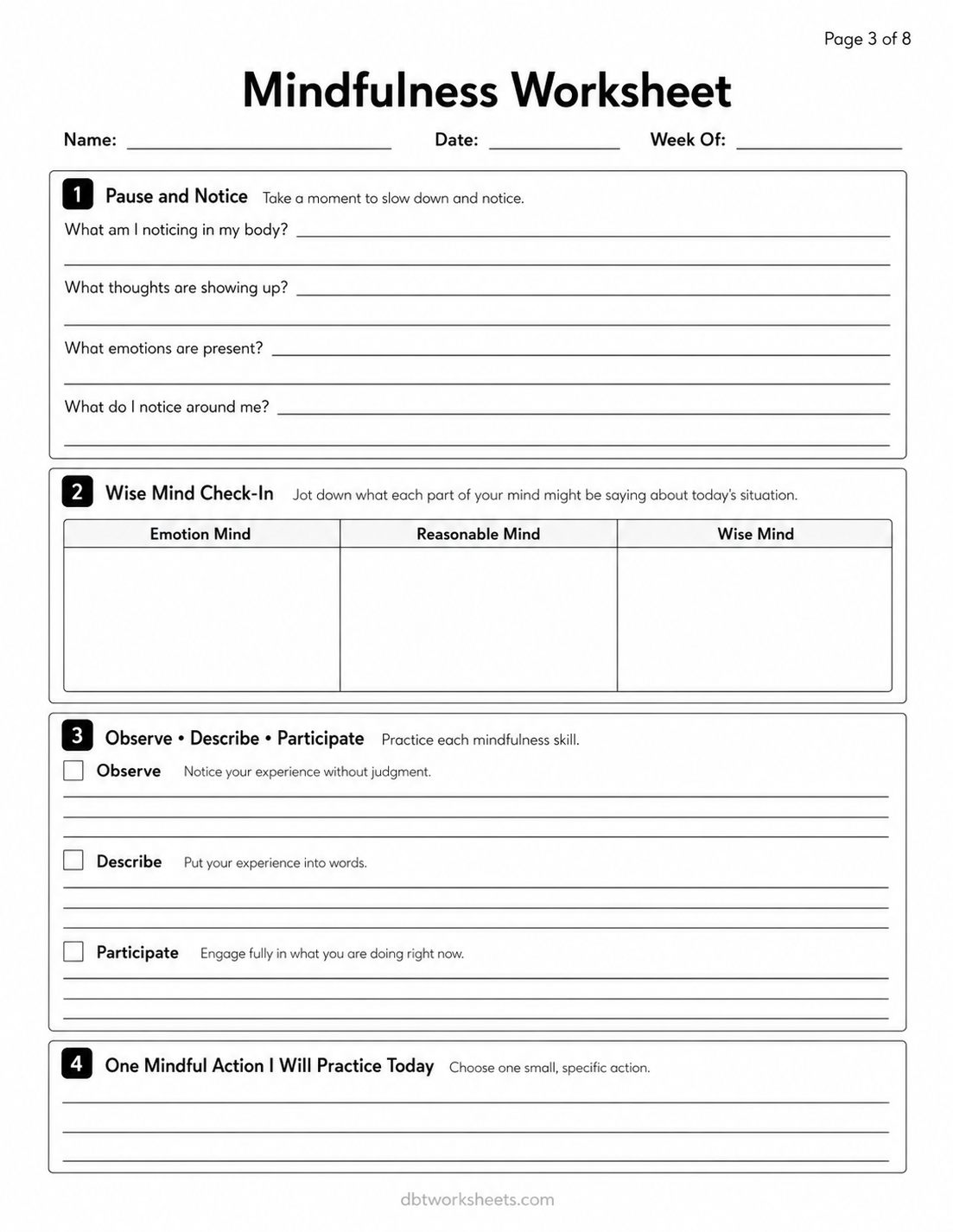
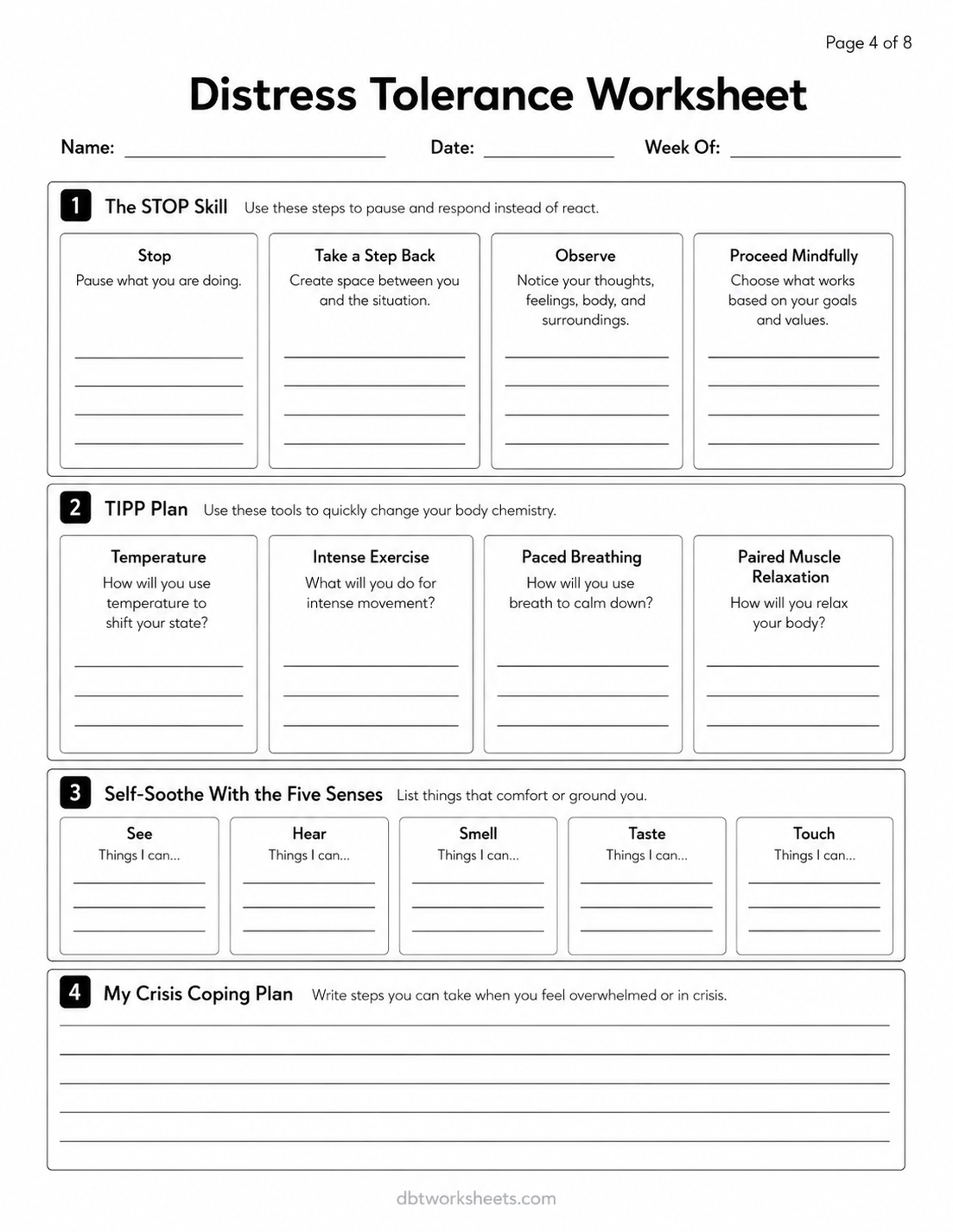
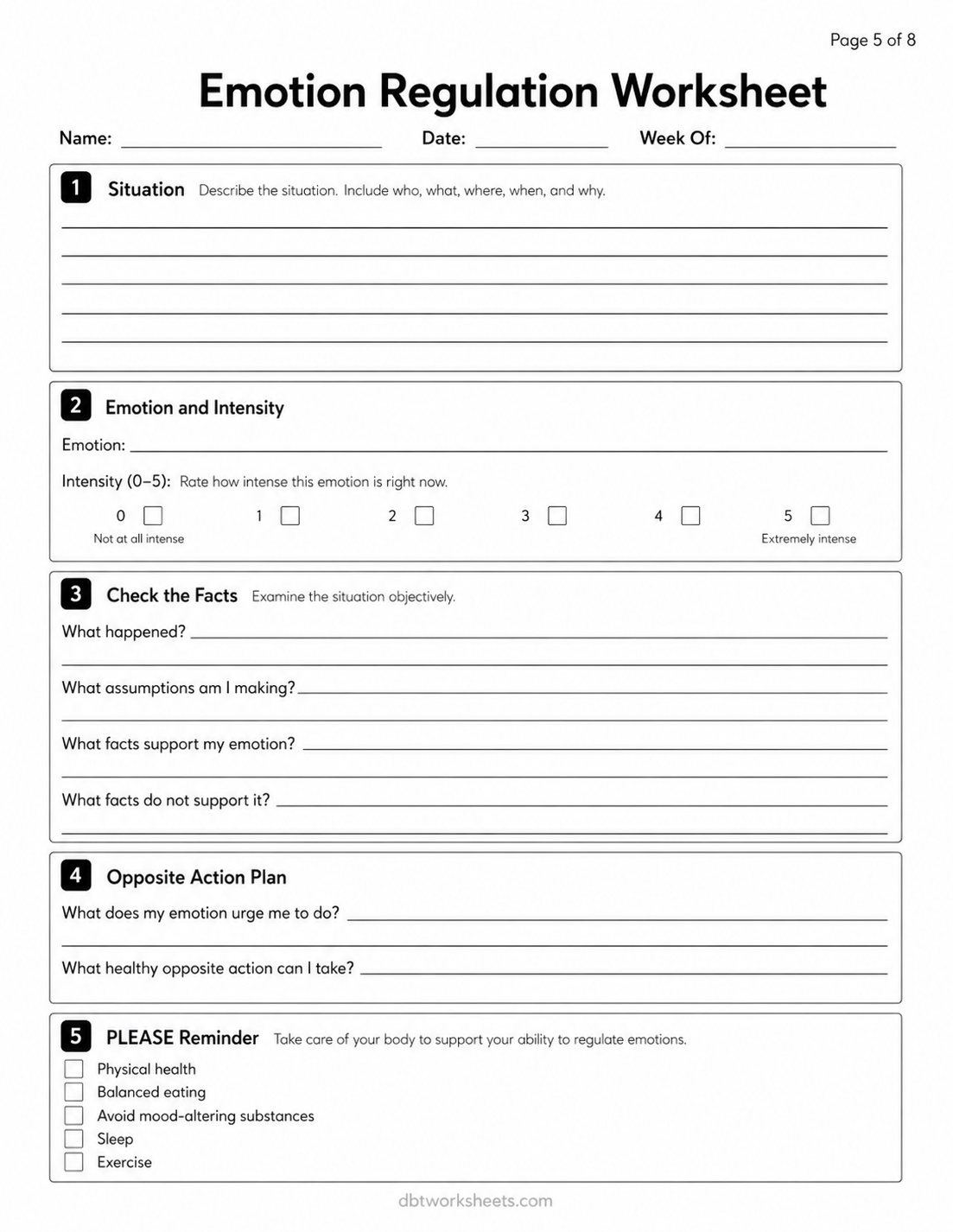
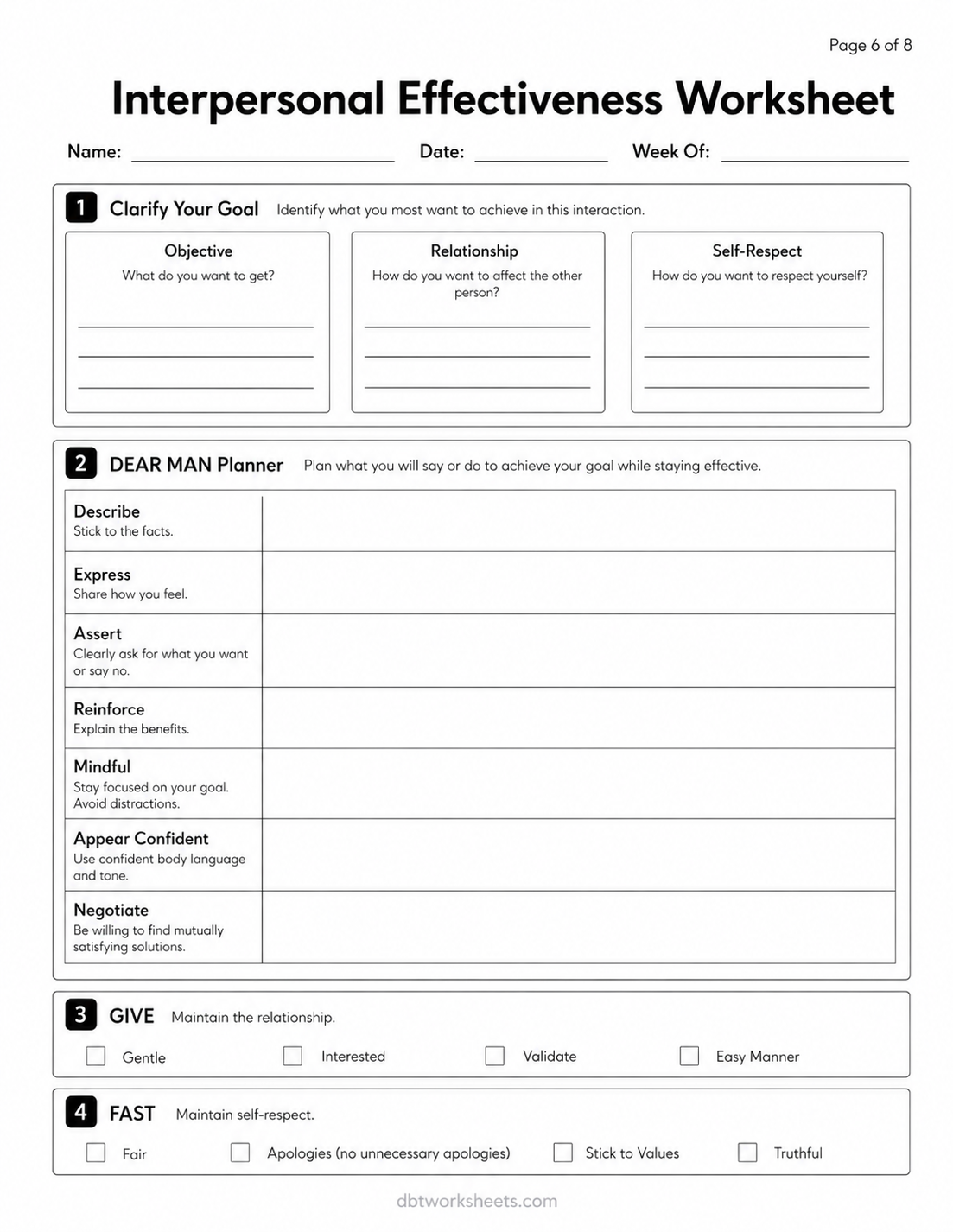
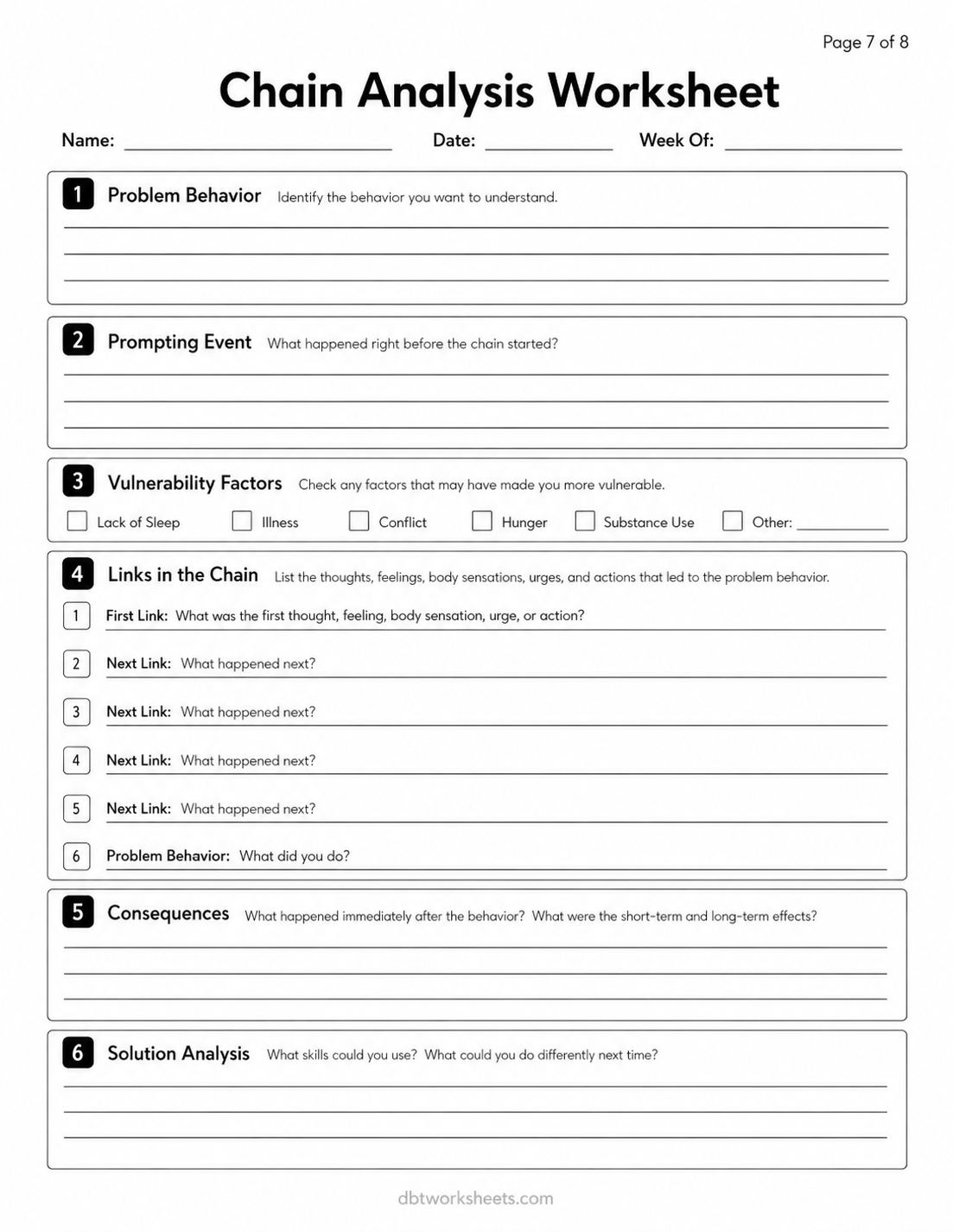
Download PDF: DBT Worksheets
Popular DBT Worksheets and How They Help
Here are widely used worksheets available from reputable therapist resources. These help turn skills into habits:
- Wise Mind Worksheet — Helps you balance “emotion mind” (feelings-driven) and “reasonable mind” (logic-driven) to access wise, values-based decisions.
- DEAR MAN Worksheet — Provides a step-by-step script for assertive, effective communication while preserving relationships and self-respect.
- Urge Surfing Worksheet — Teaches you to observe urges (like cravings or impulses) as waves that rise and fall naturally, reducing impulsive actions.
- PLEASE Skill Worksheet — Guides daily habits that reduce emotional vulnerability by addressing physical health basics.
- Radical Acceptance Worksheet — Practices acknowledging reality without judgment or resistance to reduce suffering (especially useful for grief, trauma, or unchangeable situations).
- STOP or STOPP Technique Worksheet — Quick crisis skill: Stop, Take a breath (or Observe), Pull back/notice, Proceed mindfully.
- Self-Soothing Worksheet — Uses the five senses to calm your nervous system during distress.
- Chain Analysis / Behavior Chain Analysis — Breaks down problem behaviors to understand triggers, thoughts, emotions, and consequences, then plans skillful alternatives.
These worksheets often include space for reflection, tracking practice, and real-life application examples. Many therapist sites offer them as free printable PDFs.
Where to Find Free Printable DBT Worksheets (PDFs)?
Several trusted U.S.-based or widely used resources provide free or sample DBT worksheets:
- ChoosingTherapy.com — Offers numerous free printable PDFs, including PLEASE Skill, Urge Surfing, Wise Mind, DEAR MAN, IMPROVE, Crisis Survival Skills Workbook, Radical Acceptance, mindfulness What/How Skills trackers, and more.
- Therapist Aid — Provides free DBT worksheets on topics like Behavior Chain Analysis, emotion myths, and core skills (some may require a free account).
- Other reputable sources — Sites like dbt.tools share homework handouts for distress tolerance (e.g., ACCEPTS, TIPP, Radical Acceptance) and mindfulness. New Harbinger Publications occasionally offers free DBT skills worksheet packets.
For the most comprehensive, official collection, consider purchasing DBT Skills Training Handouts and Worksheets (Second Edition or revised edition) by Marsha M. Linehan through Guilford Press. Purchasers often get access to downloadable/printable versions.
Important notes:
- Free worksheets from therapist resource sites are excellent for practice and education.
- Respect copyright — use materials only as permitted for personal or clinical use.
- These supplement, but do not replace, professional treatment.
How to Use DBT Worksheets Effectively?
- Start with awareness — Use mindfulness worksheets to build the foundation.
- Practice consistently — Dedicate time daily or several times a week. Track efforts on diary cards (common in DBT).
- Apply in real life — After filling out a DEAR MAN worksheet, role-play or use it in a low-stakes conversation.
- Review and reflect — Look for patterns with a therapist or trusted person.
- Combine approaches — Pair with apps, journals, or skills groups for better retention. Adapt for your style (color-coding, voice notes, etc.).
Best results come when worksheets are part of structured DBT with a trained therapist. Self-help use can build valuable skills and awareness but has limits for severe or high-risk situations.
Who Benefits Most from DBT Worksheets?
DBT skills and worksheets help people who experience:
- Intense or rapidly shifting emotions
- Impulsivity or self-harm urges
- Difficulty in relationships
- Chronic feelings of emptiness or identity issues
- High sensitivity to rejection or criticism
It is particularly well-supported for BPD but benefits broader populations, including those with trauma histories, eating disorders, substance use challenges, and adolescents struggling with emotion regulation.
In the U.S., DBT is used in community mental health centers, VA facilities, private practices, and telehealth platforms.
Finding DBT Therapy and Support in the United States
- Directories: Behavioral Tech (Marsha Linehan’s training organization) maintains a Find a Therapist resource. The DBT Linehan Board of Certification (DBT-LBC) lists certified clinicians.
- Psychology Today: Filter therapists by “Dialectical (DBT).”
- Insurance & Access: Many plans cover DBT under mental health benefits. Check with your insurer. Telehealth has expanded access significantly.
- Crisis Support: If you or someone you know is in emotional distress or having thoughts of suicide, call or text 988 (Suicide & Crisis Lifeline) — available 24/7, free, and confidential across the U.S.
For veterans or specific populations, inquire about specialized DBT programs through the VA or local mental health authorities.
DBT Worksheets FAQs
- Are DBT worksheets free?
Many high-quality printable PDFs are available for free from therapist resource websites. Comprehensive official collections come from books or therapy programs. - Can I use DBT worksheets on my own?
Yes for building skills and awareness, but comprehensive DBT with a trained professional yields the strongest outcomes, especially for serious concerns like self-harm or suicidal thoughts. - How long until I see results?
Many people notice improved awareness and coping within weeks of consistent practice. Deeper change often takes months and ongoing application. - Are there DBT worksheets for kids or teens?
Yes. Adapted programs (DBT-A) and kid-friendly versions exist with simpler language, visuals, and family involvement. - How do DBT worksheets differ from CBT worksheets?
DBT emphasizes both acceptance and change (the dialectic), with stronger focus on distress tolerance for very intense emotions and validation of experiences.
Start Building Emotional Skills Today
DBT worksheets provide clear, repeatable paths to greater emotional balance, healthier relationships, and reduced suffering. Whether you’re working with a therapist or exploring skills on your own, these evidence-based tools can make a meaningful difference.
Next steps:
- Download free printable DBT worksheets from trusted sites like ChoosingTherapy.com.
- Consider consulting a licensed mental health professional trained in DBT.
- Explore directories from Behavioral Tech or DBT-LBC to find support near you.
Emotional regulation is a skill anyone can strengthen with the right tools and support. Take one small step today — your future self will thank you.
This article is for educational purposes only and is not a substitute for professional mental health advice, diagnosis, or treatment. Always consult a qualified healthcare provider for personalized guidance. If you are in crisis, contact 988 immediately.